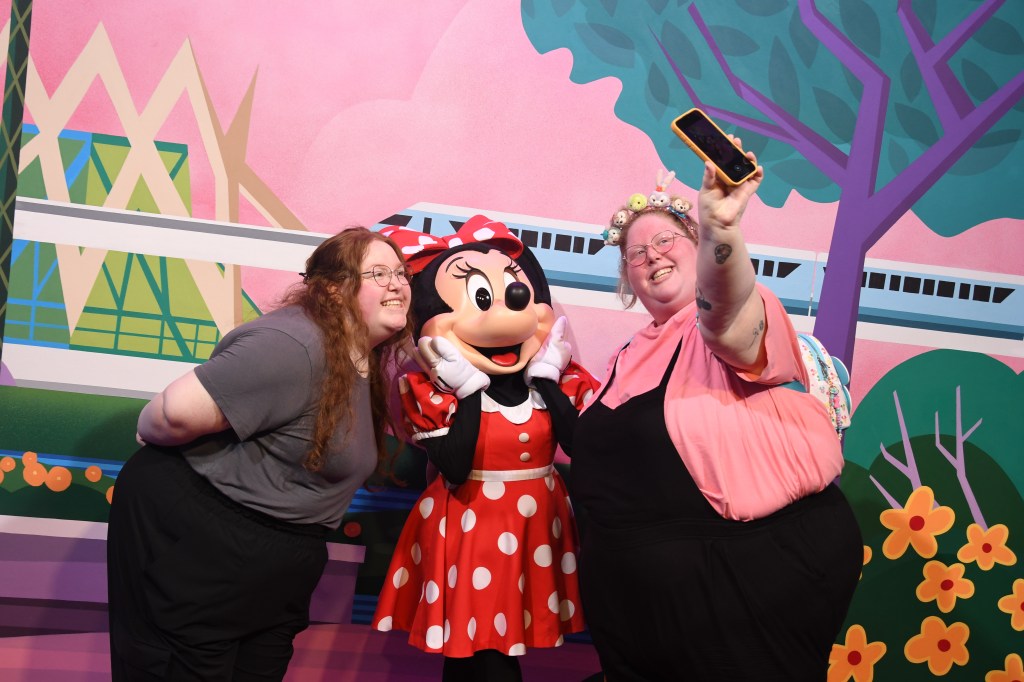
For nearly a century, The Walt Disney Company has been a leader in entertainment. Known for its movies, TV shows, theme parks, and merchandise, Disney has consistently worked to maintain control over its brand image through traditional marketing strategies. However, the emergence of social media has introduced new dynamics in brand communication. Digital creators and online content producers are playing an increasingly significant role in shaping public perception of the brand.
In today’s media landscape, where trust in traditional advertising continues to decline and digital storytelling influences brand identity, examining the role of independent Disney-focused content creators provides insight into modern marketing strategies. This story examines how Disney influencers, content creators who post about Disney experiences on platforms like TikTok and YouTube are impacting brand communication. It analyzes the strategic partnerships between creators and the company, the implications of content from underrepresented groups, and the measurable effects of influencer-driven marketing (Wang, 2024).
From Traditional Marketing to User-Generated Content
Historically, Disney has relied on advertising, press releases, and structured public relations campaigns. These materials were developed by marketing professionals and adhered to strict brand guidelines. In recent years, however, user-generated content has gained prominence. Creators are now producing videos, reviews, and visual content that reach wide audiences and are often perceived as more authentic than corporate messaging (Niu, 2025).
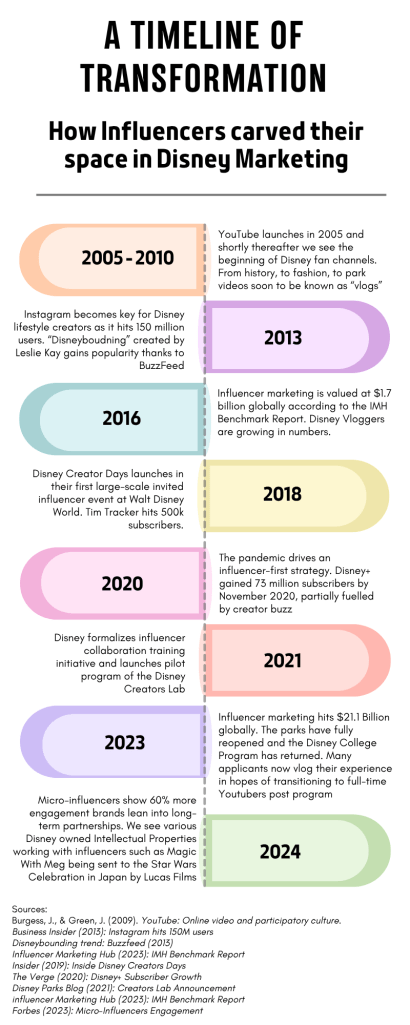
The influencer marketing industry increased in value from $1.7 billion in 2016 to $21.1 billion in 2023 (Influencer Marketing Hub, 2023). Platforms such as Instagram, TikTok, and YouTube enable creators to build engaged followings by sharing personal experiences. Approximately 71% of consumers report being more likely to make a purchase after seeing a social media recommendation (Sprout Social, 2023). These trends indicate that influencer content is playing a substantial role in shaping brand perception.
Pourkabirian et al. (2021) further demonstrate that electronic word-of-mouth (eWOM) on social platforms significantly enhances brand awareness and positively influences purchase intention, providing additional support for the growing effectiveness of influencer-driven media strategies.
Influencers as Marketing Partners
Patrick Dougall, a content creator, host, and entertainment reporter, described how participation in official events influences audience engagement. “Well…I can talk about Lilo and Stitch from my room or I can talk about it from the premiere—like what is more engaging or more exciting for the audience?” he said. Dougall, who began his career in theme park entertainment and now covers red carpets and promotional events, notes that physical access to events may enhance perceived credibility and viewer interest.
Mel Tash, a marketing expert with over ten years of experience, identified a key distinction between traditional advertising and influencer partnerships. “Influencer marketing has become really key. The difference between the two is that you’re really getting this relatable first-hand experience. The audience can see the experience through their eyes and it’s very relatable and if it’s something they haven’t already done it’s something they may want to do. That puts you in a state of where in your mind you’re already playing out the buying scenario. Psychologically that’s what makes influencer marketing so pervasive. With traditional advertising you are seeing something in your feed for half a second before you’re scrolling away. It doesn’t put you in the shoes of having that experience. There is an emotional connection to the brand, to the creator and to the buying experience which is all happening at the same time.”
Disney has responded to these developments by establishing initiatives such as the Disney Creators Lab and inviting selected creators to promotional events. These relationships allow Disney to reach targeted audience segments in a way that complements traditional campaigns. For example, a creator visiting a Disney park may produce a vlog highlighting attractions, dining, and merchandise. These videos can generate consumer interest and provide informal brand exposure. According to Padia (2025), influencer-generated content yields 11 times greater return on investment than traditional digital advertising.
Disney’s brand is strongly associated with emotional storytelling, which aligns with the style of content produced by many creators. These influencers often deliver marketing value by forming connections with their audiences through shared interests and experiences (Schivinski et al., 2016).
Authenticity and Trust
One of the central strengths of influencer content is perceived authenticity. Audiences often view influencers as more credible than traditional advertisements because their content is based on lived experiences. Topics such as accessibility, sensory accommodations, and budget travel provide information that may not be emphasized in official marketing materials.
According to Stackla (2021), 88% of consumers report that authenticity is a significant factor when determining which brands to support. This preference helps explain the effectiveness of influencer content in brand-building. However, the increasing integration of sponsored content may introduce ambiguity. As more creators participate in brand partnerships, the distinction between organic content and paid promotion may become less clear.
Federal Trade Commission (FTC) guidelines require transparent disclosure of sponsorships, but enforcement varies. Inconsistent adherence to disclosure practices may affect audience trust.
The role of user-generated content as a trust-building mechanism is also supported by recent academic findings, including a 2024 study published in California Management Review, which argues that UGC fosters trust and engagement when combined with traditional advertising strategies (Is User-Generated Content a Double-Edged Sword?, 2024).
Access and the “Inner Circle”
Alexx, a TikTok Shop affiliate manager at Super Ordinary, provided insight into the selection process for Disney Creator Labs and similar programs. “I think the barriers especially right now, is that you have a lot of content creators that have been in this space for a lot longer and those are the creators Disney typically turns to because they are trusted,” she said. “They’re trusted to give family friendly content, they are quote on quote ‘Brand safe’ and when it comes to those that are not within the niche then typically you’re probably not going to be selected. But on the outside of that I have seen Disney content creators go outside of their niche. The barrier is that if you’re not already niched into Disney then you need to niche into Disney and that’s the first barrier you have to get through right now. Whatever content you have make it into Disney. Start posting and continuously posting about Disney and then niche into other things. Disney wants to see Disney first.”
Creators who are invited to participate in events or receive early access to products often experience increased visibility. However, this process has led to a stratified ecosystem in which a select group of influencers receives regular access, while others may struggle to gain recognition. Creators focusing on areas such as mental health, inclusivity, and disability advocacy may not receive the same promotional opportunities despite producing content with high engagement and community value.
The Rise of Micro-Influencers and Inclusive Content
Micro-influencers—creators with fewer than 100,000 followers—are gaining importance due to higher engagement rates and stronger community ties. Forbes (2023) reports that micro-influencers achieve 60% more engagement than macro-influencers. In the context of Disney content, these creators often address topics such as accessibility, representation, and cultural inclusivity.
Stephanie, a member of Plus Size Park Hoppers, discussed her group’s content strategy, which includes showcasing ride vehicle dimensions, accessibility for wheelchair users, and merchandise sizing. “I think it would be cool if Disney would participate in content that people are already doing to help promote accessibility in general,” she stated. “Or if they were to work with us on our videos about ride accessibility or something like that. The content is out there and if they were just involved into it I think it would be a natural way to promote that thing.”
Groups like Plus Size Park Hoppers produce informational content that may support guest preparedness and highlight gaps in existing marketing. These creators often work without formal compensation but can nonetheless influence audience expectations and brand perception.
The Challenges of Working with Influencers
While influencers can provide marketing value, challenges remain. Content that contradicts brand messaging or generates controversy may result in reputational risk. Additionally, as influencer partnerships become more commercialized, there is a potential for audiences to perceive content as less genuine.
To address these concerns, companies may prioritize long-term collaborations with creators whose values align with brand standards. Transparency in sponsorship and consistency in messaging can help maintain audience trust. As consumers become more aware of influencer marketing, ethical practices and clear communication may become increasingly important.
The Future: Collaboration and Shared Storytelling
Maria Gonzalez, a senior analyst on the analytics team at Zenith, commented on current trends in influencer marketing. “It’s definitely blending…they are not just using influencers to promote anymore they are using the influencers to create or be the entertainment themselves,” she said. “They are not just people who are posting on their behalf they’re truly partners. I think this concept of partners is something that I’ve seen evolve over time and brands keep these partners on their roster and it’s pretty collaborative. They will keep coming back to them. Micro influencer all the way through influencers can be partners and it’s not just a one and done situation.”
As digital platforms continue to evolve, brands may adjust their approach to include co-creation and more inclusive storytelling models. In this context, influencers function not only as marketers but as strategic collaborators in the brand-building process.
Future marketing initiatives are expected to emphasize inclusion, representation, and audience connection. The distinction between fan and marketer is becoming less pronounced, prompting brands to reconsider how narratives are shaped and shared in partnership with content creators.
Conclusion
Influencer marketing has become a central component of brand strategy in the entertainment industry. In the case of Disney, content creators contribute significantly to how the brand is presented, perceived, and experienced. Their influence spans product awareness, guest preparation, and brand loyalty.
While challenges related to transparency and brand alignment persist, influencer partnerships provide a valuable opportunity for targeted communication and consumer engagement. As the marketing landscape continues to shift, integrating independent voices into brand narratives is becoming a standard practice rather than a supplementary strategy.
To extend this analysis, a curated playlist of content creators whose work reflects the themes discussed in this paper is available. These examples offer practical insights into the strategies, challenges, and creative approaches influencing modern brand engagement and may serve as a resource for further academic or professional exploration.
References
Influencer Marketing Hub. (2023). Influencer Marketing Benchmark Report 2023. https://influencermarketinghub.com/influencer-marketing-benchmark-report/
Keval Padia, By, & Keval PadiaNimblechappsKeval Padia is a co-founder of Nimblechapps. (2025, June 3). Keval Padia. CustomerThink. https://customerthink.com/the-roi-of-influencer-marketing-is-it-still-worth-it/#:~:text=A%20striking%2089%25%20of%20marketers,when%20campaigns%20are%20well%2Dexecuted.
Is User-Generated Content a Double-Edged Sword? (2024). California Management Review. https://cmr.berkeley.edu/
Nielsen. (2022). Influencer marketing ROI: How does it compare to other digital channels? https://www.nielsen.com/us/en/insights/article/2022/influencer-marketing-roi-how-does-it-compare/
Niu, Y. (2025). Influence of user-generated content on brand trust and customer engagement. Journal of Marketing Management, 41(2), 210-227.
Pourkabirian, S., Tavakkoli, S., & Karimian, M. (2021). The impact of electronic word-of-mouth on brand awareness and purchase intention. International Journal of Marketing Studies, 13(3), 45-60.
Stackla. (2017, November 9). The consumer content report: Influence in the Digital age. WFA. https://wfanet.org/knowledge/diversity-and-inclusion/item/2017/11/09/The-Consumer-Content-Report-Influence-in-the-Digital-Age
Schivinski, B., Christodoulides, G., & Dabrowski, D. (2016). Measuring consumers’ engagement with brand-related social-media content: Development and validation of a scale. Journal of Interactive Marketing, 32, 57-74.
Sprout Social. (2023). 2023 Social Media Trends Report. https://sproutsocial.com/insights/social-media-trends/
Forbes. (2024). The Power of Micro Influencers: Marketing’s New Frontier https://councils.forbes.com/blog/the-power-of-micro-influencers
Wang, X. (2024). Disney’s global marketing strategy: Emotional connection, brand expansion, and media convergence. Global Media Studies, 29(1), 14-32.
Sih-Tseng, K. (2022, April 29). Here’s everything you need to know about disney creators celebration. Keshia Sih. https://www.keshiasih.com/blog/disney-creators-celebration



 Savannah Dison
Leave a comment